Essential for Construction Planning
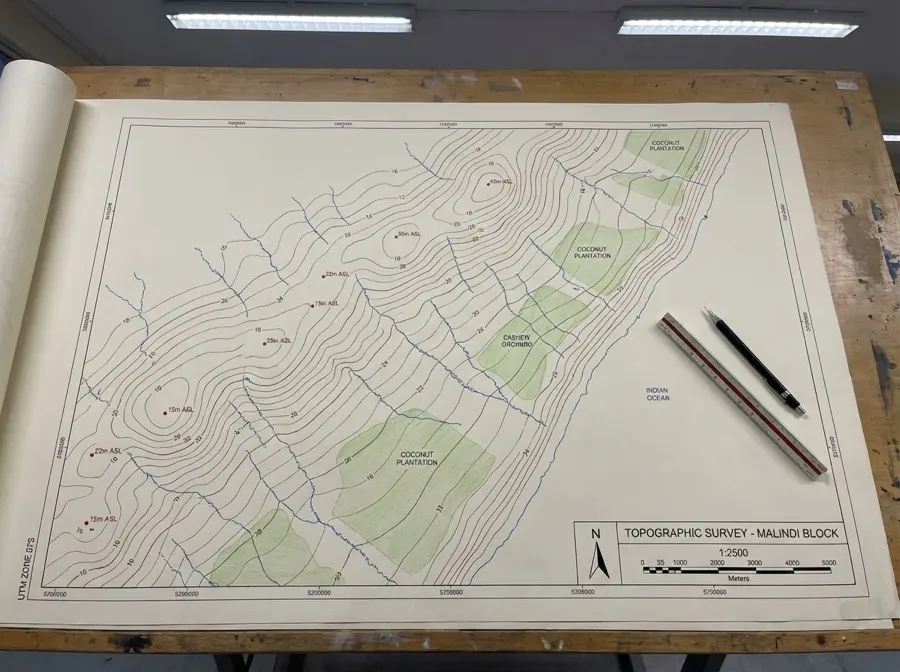
A topographic survey, also called a topographical survey, maps the shape and features of your land. It shows elevation changes, slopes, drainage patterns, and existing structures. This information is essential before any construction because it determines foundation design, drainage solutions, and earthwork costs. Our topographic surveys provide the detailed elevation data, contours, and natural features essential for architectural design, civil engineering, and construction projects.
From residential site development to large infrastructure projects, our topographic surveys deliver the precision terrain data engineers and architects need for successful project planning.
Topographic Applications
Site Development Planning
Architectural and engineering design informed by accurate terrain data. Optimizes building placement and site grading
Engineering Design Support
Precise elevation data for civil and structural design. Foundation planning, drainage systems, and retaining walls
Terrain & Drainage Analysis
Digital Elevation Models (DEM) for grading plans, stormwater management, and flood risk assessment
Cut-and-Fill Volume Calculations
Earthwork calculations for construction budgeting. Know excavation and fill requirements before breaking ground
Infrastructure Route Planning
Road alignment planning, pipeline routes, and utility corridor mapping with terrain optimization
As-Existing Documentation
Pre-construction surveys documenting current site conditions for design baseline and future comparison
When Do You Need a Topographic Survey?
Before Building Permit Application
Most Kenyan county governments require topographic surveys for building permit approval, especially for sites with slopes greater than 10% or drainage issues. The survey proves your proposed building design accounts for terrain and stormwater management.
Site Development Planning
Architects and engineers need accurate elevation data to design buildings that fit naturally into the landscape. A topographic survey helps determine optimal building placement, access road alignment, and parking lot grading to minimize earthwork costs.
Drainage and Stormwater Design
Water always flows downhill. A topographic survey shows exactly which direction water will flow across your site, allowing civil engineers to design proper drainage systems, retention ponds, and stormwater outlets that comply with National Construction Authority (NCA) standards.
Cut-and-Fill Earthwork Estimation
Before construction begins, contractors need to know how much soil must be excavated (cut) and how much must be added (fill) to achieve the final site grades. A topographic survey with Digital Elevation Model (DEM, a computer model of terrain heights) allows accurate volume calculations, preventing budget surprises.
Slope Stability Assessment
Building on steep slopes requires geotechnical analysis. A topographic survey provides the baseline terrain data geotechnical engineers need to assess landslide risk, design retaining walls, and specify foundation types. This is critical in hilly areas like Nairobi's Westlands or coastal escarpments.
Infrastructure Corridor Planning
Roads, pipelines, power lines, and water mains must follow terrain efficiently. A topographic survey allows engineers to optimize alignments, minimize steep grades, and avoid expensive rock excavation. This is essential for KeRRA road projects and county infrastructure development.
Technology & Accuracy
CORS-enabled RTK GNSS, robotic total stations, and drone photogrammetry for rapid large-area coverage. Accuracy: ±50mm horizontal, ±20mm vertical. Deliverables: DWG, DXF, LandXML, PDF formats compatible with AutoCAD Civil 3D and other design software.
What You Receive: Survey Deliverables
Contour Plans
Detailed maps with contour lines at specified intervals (typically 0.5m, 1m, or 2m depending on project requirements). Shows elevation changes, existing features, and drainage patterns. Format: AutoCAD DWG, DXF, PDF
Digital Elevation Models (DEM)
3D computer models of your terrain. Engineers import these into Civil 3D, Autodesk Revit, or other design software for grading plans, drainage analysis, and earthwork calculations. Drone surveys provide high-resolution DEMs covering large areas rapidly. Format: GeoTIFF, LAS point cloud, LandXML
Spot Height Tables
Exact elevation measurements at key locations like building corners, road intersections, drainage inlets, and property boundaries. Essential for construction layout and verification. Format: CSV, Excel, PDF report
Feature Surveys
Locations of existing structures, utilities, trees, fences, roads, and other site features. Helps architects design around existing conditions and avoid utility conflicts during construction. Format: AutoCAD DWG with attributed blocks
Cross-Sections
Vertical slices through your terrain showing elevation profiles. Critical for road design, pipeline installation, and understanding subsurface conditions. Engineers use these to design cut-and-fill slopes and drainage gradients. Format: AutoCAD DWG, PDF
Volume Calculations
Earthwork quantity reports comparing existing terrain to proposed grading plans. Shows cubic meters of cut and fill, helping contractors prepare accurate bids and avoid cost overruns. Format: PDF report with tabular summaries
Common Questions About Topographic Surveys
What is a contour line and why does it matter? +
A contour line connects points of equal elevation, like tracing around a mountain at the same height. When contour lines are close together, the slope is steep. When they are far apart, the land is relatively flat. Architects use contour lines to design buildings that fit the natural slope, reducing expensive earthwork. Engineers use them to design drainage systems that move water away from buildings efficiently. In simple terms, contour lines show you the shape of your land from above.
What contour interval do I need for my project? +
The contour interval (vertical distance between contour lines) depends on your project size and terrain. Flat sites or large infrastructure projects typically use 1m or 2m intervals. Hilly residential sites or detailed architectural projects use 0.5m or 1m intervals for better precision. Building permits in most Kenyan counties accept 1m intervals for standard residential plots. Your surveyor will recommend the appropriate interval based on site conditions and intended use.
What is the difference between topographic and cadastral surveys? +
A cadastral survey defines property boundaries and ownership. It answers the question: Where does my land start and end? A topographic survey maps the shape and features of the land within those boundaries. It answers the question: What does my land look like? Most development projects need both. First, a cadastral survey establishes legal boundaries. Then, a topographic survey provides the terrain data architects and engineers need for design.
Do I need a topographic survey for my building permit in Kenya? +
It depends on your county and site conditions. Nairobi City County, Kiambu County, and Mombasa County typically require topographic surveys for sites with slopes greater than 10%, drainage concerns, or multi-story buildings. Kilifi County and coastal counties often require them for any development larger than a single-story residential house. Check with your county physical planning office. Even if not legally required, architects and engineers strongly recommend topographic surveys before design to avoid costly mistakes during construction.
How long does a topographic survey take? +
Fieldwork time depends on site size and complexity. A typical half-acre residential plot takes 1-2 days for data collection. Processing, modeling, and drawing production add another 3-5 working days. Large sites (10+ acres) benefit from drone surveys, which can map 40+ hectares per day but require 5-7 days for data processing and DEM generation. We provide detailed timelines during project quotation based on your specific site conditions.
What equipment do you use for topographic surveys? +
We use CORS-enabled RTK GNSS receivers for accurate positioning (±20mm vertical accuracy), robotic total stations for detailed spot heights and feature mapping, and DJI Phantom 4 RTK or Mavic 3 Enterprise drones for rapid large-area coverage. Drones are especially efficient for sites larger than 5 acres, steep terrain, or areas with difficult access. All equipment is calibrated regularly and tied to Kenya Survey Department geodetic control for national datum compliance. Our KCAA-licensed pilots conduct all drone operations in accordance with civil aviation regulations.
Need Topographic Survey?
Topographic survey costs typically range from KES 80,000-250,000 depending on site size, terrain complexity, and contour interval required. Drone surveys available for large areas (40+ hectares/day). Contact us for accurate pricing.