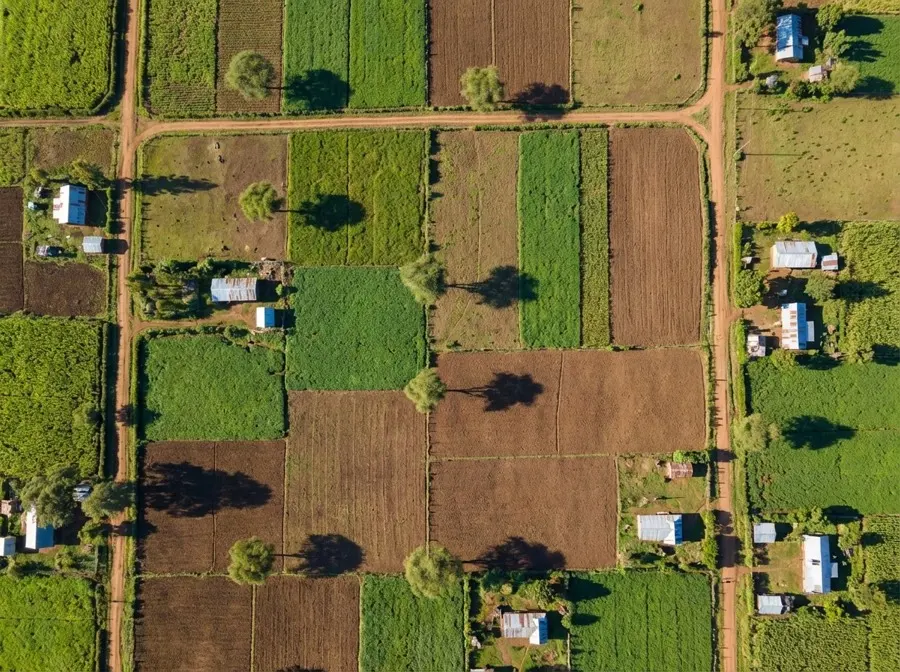
Modern Surveying Technology
Drone surveying uses unmanned aerial vehicles to capture hundreds of overlapping aerial photographs. Specialized software then stitches these images together to create accurate maps and 3D models. This technique is called photogrammetry. Think of it like taking many pictures of your property from different angles in the sky, then using a computer to build an exact copy of your land in digital form. With RTK (Real-Time Kinematic) GPS technology, we achieve centimeter-level accuracy, similar to the precision of traditional ground surveying but faster and safer. Our DJI Phantom 4 RTK and Mavic 3 Enterprise drones equipped with high-resolution cameras provide rapid, accurate aerial surveys for large properties, construction sites, infrastructure projects, and mining operations.
Why choose drone surveys? For large areas above 10 hectares, drones are significantly faster and more affordable than traditional methods. While traditional surveyors might map 2 to 5 hectares per day, our drones cover 40 or more hectares in the same time. This speed advantage translates to lower costs, especially for farms, quarries, road corridors, and development sites. From marketing visuals for property developers to detailed topographic surveys for engineering projects, our KCAA-licensed drone services deliver professional results faster and more cost-effectively than traditional ground methods. The resulting maps and models can be used for planning, design, volume calculations, marketing, and documentation across many industries in Kenya.
Drone Survey Services
Aerial Photography & Videography
High-resolution images and 4K video for property marketing, progress monitoring, and project documentation
Orthophoto Mapping
Geometrically corrected aerial maps (like Google Earth but current and accurate) for precise measurements and planning
3D Modeling & Digital Elevation Models (DEM)
3D terrain visualization, Digital Surface Models (DSM), and contour maps for engineering design
Volume Calculations
Stockpile measurements for construction materials, mining operations, and quarries. Accurate inventory for billing and production reporting
Mining & Quarry Volume Surveys
Monthly stockpile measurements (ballast, sand, minerals) for production reporting and inventory management. Drone photogrammetry delivers fast, accurate volumes cost-effectively for large operations.
Progress Monitoring
Regular aerial surveys to track construction and development progress. Time-series imagery for project management
Infrastructure Inspection
Building, tower, bridge, and power line inspections without scaffolding or crane access
How Drone Surveying Works
Flight Planning and Airspace Authorization
We design the flight mission to cover your entire site with proper image overlap (typically 70-80%). Before flying, we obtain necessary airspace clearances from KCAA, especially important near airports, urban areas, or restricted zones. Flight planning software calculates optimal altitude, speed, and camera settings for your specific accuracy requirements.
Ground Control Point Placement
For survey-grade accuracy, we place visible ground markers (GCPs) at known coordinates across your site. These targets, measured with high-precision GNSS equipment, allow us to verify and improve the final map accuracy to within 2-5 centimeters. For basic mapping projects without strict accuracy requirements, we may rely on RTK GPS alone.
Drone Flight and Image Capture
Our KCAA-licensed pilot flies the pre-programmed mission while monitoring weather, airspace, and drone systems. The drone automatically captures hundreds or thousands of images with precise GPS coordinates for each photo. A typical 40-hectare flight takes 2-3 hours including setup and safety checks. Weather must be clear with wind below 10 meters per second for optimal results.
Photogrammetric Processing
Back in our office, specialized software analyzes the overlapping images to identify common features and reconstruct the 3D geometry of your land. This process, called Structure from Motion (SfM), uses the same principles your eyes use to judge distance. Processing time ranges from hours to days depending on project size and required outputs.
Deliverable Generation
The processed data produces multiple outputs: orthophoto maps (geometrically correct aerial photos for measurement), Digital Elevation Models (DEM showing ground surface), Digital Surface Models (DSM including buildings and vegetation), 3D point clouds, contour maps, and volume calculations. All deliverables are provided in industry-standard formats compatible with CAD, GIS, and engineering software.
Regulatory Compliance in Kenya
KCAA Licensing Requirements
All commercial drone operations in Kenya must comply with Kenya Civil Aviation Authority regulations. Walterland holds current Remote Aircraft Operator Certificates (ROC) authorizing legal survey operations nationwide. Operating without proper certification is illegal and can result in fines or equipment confiscation.
Remote Pilot License (RPL)
Our pilots hold valid KCAA Remote Pilot Licenses obtained through approved training programs and examinations covering airspace regulations, meteorology, flight operations, and emergency procedures. RPL holders must maintain currency through regular flight operations and periodic renewals.
Airspace Classifications and Restricted Zones
Kenya airspace is divided into controlled and uncontrolled zones. Flights near airports, military installations, government buildings, or above 400 feet (120 meters) often require special operational authorization. We handle all airspace clearance applications as part of project planning. Some areas, such as around Jomo Kenyatta International Airport or military bases, may prohibit drone operations entirely.
Privacy and Property Considerations
While airspace is public, capturing images of private property for commercial purposes requires landowner permission. We obtain necessary consents before surveying. For large infrastructure projects crossing multiple properties, client authorization letters may be required. Our operations respect privacy and avoid unnecessary image capture of neighboring properties.
Perfect For
Property Developers
Marketing visuals, site planning, and progress documentation for tourism, residential, and commercial projects
Construction Sites
Topographic surveys, earthwork calculations, and regular progress monitoring for contractors and project managers
Large Farms & Plantations
Agricultural mapping, irrigation planning, crop health monitoring, and precision agriculture data collection
Mining & Quarries
Monthly volume surveys for production reporting, stockpile inventory, and quarry progression monitoring
Government Infrastructure
Road corridor mapping (40+ hectares/day), right-of-way surveys, and as-built documentation for KeRRA/KeNHA projects
Technology & Accuracy
DJI Phantom 4 RTK and Mavic 3 Enterprise drones with centimeter-level positioning accuracy. Ground Control Points (GCP) established for survey-grade accuracy validation. All flights conducted by KCAA-licensed pilots with current Remote Aircraft Operators Certificates (ROC).
Accuracy Comparison
RTK Drone Survey (with GCPs)
Accuracy: 2-5 cm horizontal and vertical Speed: 40+ hectares per day Cost: Low per hectare for large areas Best for: Large open areas, quarries, farms, infrastructure corridors where speed matters
Traditional Ground Survey (Total Station)
Accuracy: 1-2 cm horizontal and vertical Speed: 2-5 hectares per day Cost: High per hectare for large areas Best for: Small sites, legal boundaries, construction staking, areas with heavy vegetation
When to Use Each Method
Accuracy: Both methods achieve survey-grade accuracy Speed: Choose based on project size and vegetation Cost: Drone advantage grows with area size Best for: For cadastral boundaries and legal surveys, traditional methods remain preferred. For topography, volumes, and mapping over 10 hectares, drones provide better value. Often, combining both methods delivers optimal results: drones for overall mapping, ground surveys for critical detail areas.
Common Questions About Drone Surveys
What is photogrammetry and how does it work? +
Photogrammetry is the science of making measurements from photographs. When you take pictures of an object from multiple angles, software can identify the same features in different images and calculate their 3D position. This is similar to how your two eyes work together to judge distance. For drone surveys, we capture hundreds of overlapping aerial photos, and specialized software reconstructs your land in accurate 3D digital form. The result is detailed maps and models you can measure, just like the real terrain.
How accurate are drone surveys compared to traditional methods? +
With proper ground control points, drone surveys achieve 2-5 cm accuracy, which meets requirements for most engineering, construction, and agricultural applications. Traditional ground surveys with total stations can be slightly more accurate (1-2 cm) but are much slower and more expensive for large areas. For legal cadastral boundaries, traditional methods remain the standard. For topographic mapping, volume calculations, and site planning, drone accuracy is more than sufficient and far more cost-effective.
What weather conditions are required for drone surveying? +
We need clear skies with good visibility and wind below 10 meters per second (about 36 km/h). Rain, fog, or heavy clouds prevent flying. Strong sun directly overhead (10am-2pm) produces the best, most evenly-lit images. Shadows from morning or evening sun can affect accuracy. During Kenya's rainy seasons (March-May, October-December), we schedule flights for clear weather windows. Most projects can be completed within a few days when weather cooperates.
Do you need permission to fly drones in Kenya? +
Yes. All commercial drone operations require KCAA certification. Walterland holds current Remote Aircraft Operator Certificates (ROC) and our pilots have valid Remote Pilot Licenses (RPL). Additionally, specific flights may require airspace authorization depending on location, especially near airports, urban areas, or government facilities. We handle all regulatory compliance and authorization applications as part of our service. Never hire uncertified drone operators as this violates Kenyan aviation law.
How large an area can you survey in one day? +
For typical mapping projects, we can cover 40-60 hectares per day with a single drone and pilot. Larger areas require multiple days or multiple drone teams. Very large projects (500+ hectares) such as road corridors or mining sites may take a week or more. Flight time per battery is about 25-30 minutes, and we need time for setup, battery changes, ground control point placement, and safety procedures. Weather delays can extend timeline.
What deliverables will I receive from a drone survey? +
Standard deliverables include: orthophoto maps (georeferenced aerial images for measurement), Digital Elevation Models (DEM showing ground surface), Digital Surface Models (DSM including all features), contour maps at your specified interval, 3D point clouds, and volume calculations if requested. Files are provided in industry-standard formats such as GeoTIFF, DXF, LAS, and PDF. All data is georeferenced to Kenya national coordinate systems for use in CAD, GIS, or engineering software. We can customize outputs to match your specific project requirements.
Ready for Modern Aerial Surveying?
Drone survey costs typically range from KES 5,000-10,000 per hectare with volume discounts for large areas (100+ hectares). Includes orthophoto maps, DEMs, and 3D models. Contact us for project-specific pricing.